 |
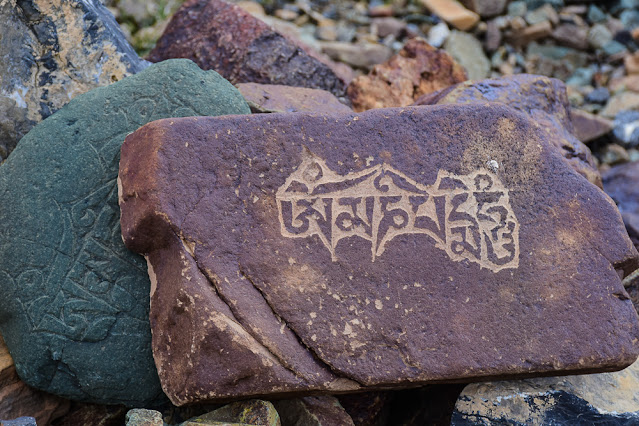
| Om Mani Padme Hum |
Lipah, Bali, December 31, 2024
It is that time of year again when it’s time to cast
my mind back over the past 365 days and remember what I got up to this year,
and what I did with the precious gift of time. It was an unusually quiet year
from the travel point of view, after a few years of frenetic movement. I didn’t
visit a single new country, something that is a relatively rarity for me; I
resolve to do better at that in 2025!
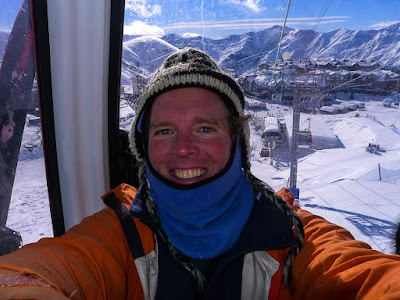 |
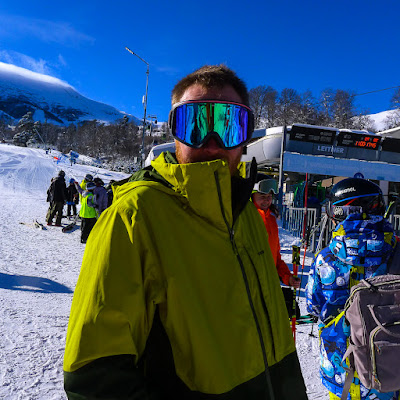
On the lift in Gudauri
|
 |
| With my colleague Greg in Bakuriani |
The year began in Leysin, Switzerland, where I was
staying with my sister Audie and her family after the end of Stanley’s Travels.
A couple of days after New Year’s, I packed my life into a couple of backpacks,
plus a bicycle and a ski bag, and flew to Tbilisi, Georgia, where I had
accepted a mid-year position teaching mathematics at QSI Tbilisi, the
international school where I had taught science from 2018 to 2020. I was
excited to return to Georgia, one of my favourite countries in the world, and
also looking forward to recharging my financial reserves after a few years of
economic inactivity. Since I was only going to be there for five months, and
since Terri and I had done a lot of exploring of Georgia and the rest of the
South Caucasus during our previous stint there, Terri elected to spend the time
in Bali and visiting family in New Zealand.
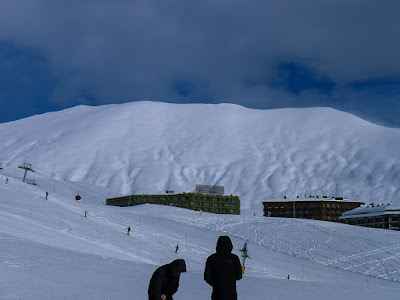 |
My favourite descent in Gudauri
|
I was inheriting not only my predecessor’s classes,
but also his apartment. Although it was a really well-appointed apartment in a
fairly fancy apartment building on Abashidze Street, one of the swankiest
streets in the upmarket Vake neighbourhood, its location was really poor for
someone who had to commute 17 km every morning and evening to the far northern
suburb of Dighomi. During my first stint in Tbilisi, Terri and I had lived
about a 10-minute bicycle ride or a 15-minute stroll from school, and I had appreciated
how little time I spent commuting. This time was different, as every morning I
caught a staff bus at 7:15 am through light morning traffic and then caught a
taxi home through Tbilisi’s notoriously dense afternoon rush hour congestion.
The morning trip took about 25 minutes; on a lucky day I could get home in 45
minutes, but it sometimes took well over an hour. I hate being stuck in
traffic, and I hadn’t had an appreciable commute to work in 18 years, since my
time teaching in Nihonmatsu, Japan. As the weeks progressed, I could feel my
mood darkening, and I often arrived home feeling utterly drained and immensely
frustrated by crawling through stop-go traffic or sitting in hopeless traffic
jams for what seemed like hours.
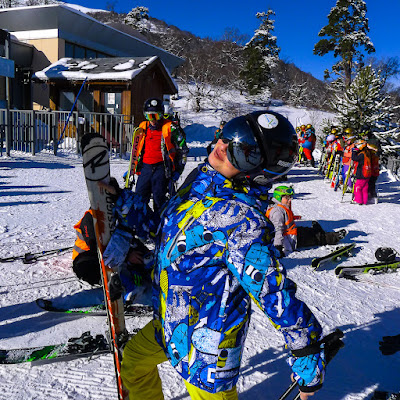 |
My colleague Ana in Bakuriani
|
QSI had shrunk in numbers since I was last there,
largely due to the pandemic, and it soon became clear that a lot of mathematics
hadn’t been taught to the students over the previous few years. Several of my
classes were really far behind where they should have been, with a lot of
confused students. It made for a lot of hard work, extra help sessions and
scrambling to get the courses completed in time. I found it stressful and not
as much fun as it had been the first time around; it’s always hard to come in
halfway through the year! In the end, though, I managed to get almost everyone
through their required units of mathematics, and my AP Statistics students
performed well on their exams, so I guess all’s well that ends well.
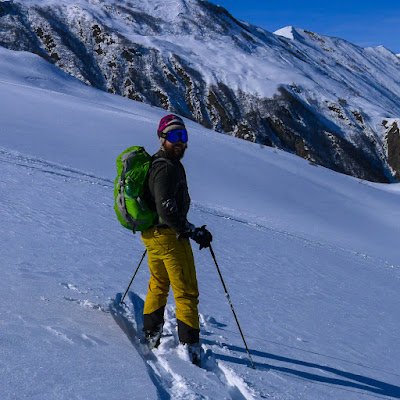 |
On the way up to Lomisa Monastery
|
I tried to get out and about on weekends, at first
joining a ski group that headed up every Saturday to Gudauri. As was the case
previously, it wasn’t a particularly brilliant ski season, with not much snow
at times, and it wasn’t the hit of adrenaline and pure fun that I was craving. The most fun I had skiing was accompanying the junior high school, and then the following week the high school, on the annual school ski trip to Bakuriani. The kids were enthusiastic skiers, well behaved and a lot of fun to hang around with on the slopes. I also had a great day of ski touring with an American friend up to Lomisa Monastery on a day with unusually good snow.
During the week I was frequently home quite late and lacking in energy to do
much other than to go to the gym and pool in the basement of my apartment
complex. My one real weekly social staple was attending Tuesday evening pub
quizzes at Pub 44, where I took my turn every few weeks as the quizmaster. When
I wasn’t hosting, my teams did fairly well, although there was stiff
competition from some of the other teams who had some very knowledgeable
members.
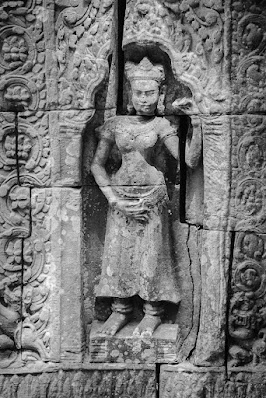 |
Angkor style
|
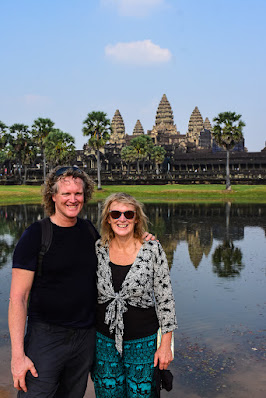 |
| Angkor Wat |
At the end of March I had a week off for spring break,
and I flew to Cambodia to meet up with Terri. It had been 23 years since I was
last at Angkor Wat, and Terri had never been there, so we spent a lovely,
leisurely week poking around the immense Angkor complex and around
further-flung temples, some of which were new to me. Angkor and its art continue to be the most impressive ruins I have ever seen anywhere in the world, and I was ecstatic to be back again. We rented a motor scooter
and spent our days zipping out to distant temples, crawling through the ruins,
climbing up to viewpoints, photographing and trying to make sense of the intricate
bas-relief carvings that adorn so many of the walls. It’s precisely the sort of
travel that I enjoy, delving deep into the history and culture of a country,
and Terri and I had a fabulous week. All too soon it was time to fly back to
Tbilisi for my last two and a half months.
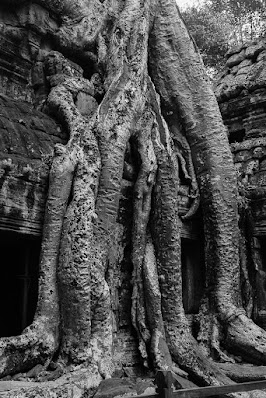 |
Giant trees envelop the ruins
|
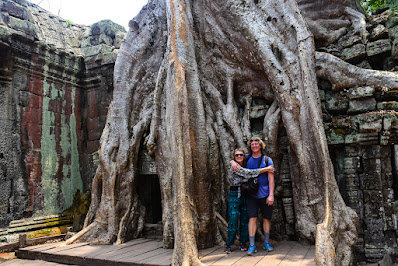 |
At Ta Prohm
|
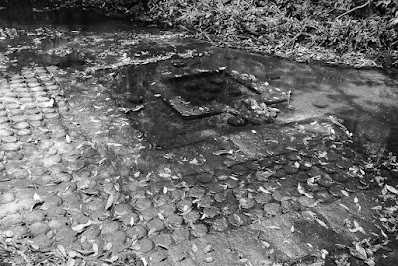 |
Ancient Shiva lingams in a river, Kbal Spean
|
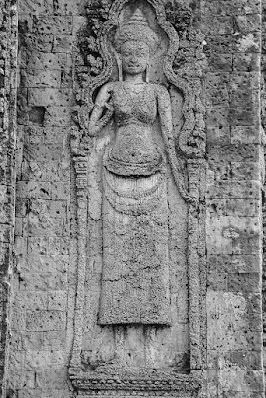 |
More Angkorian carving
|
When I returned winter was over and it was both warm
enough and light early enough for me to forsake the staff bus and the hated
taxis and start cycling to work. It took about 50 minutes in the morning and 55
minutes coming home, so it took not much more time than going by vehicle, and
it left me feeling a lot more positive. It was also warm enough to start
playing tennis with my colleague and fellow tennis fanatic Greg; we had many an
after-work match, with me winning more often than not, but usually featuring
lots of hard-fought points.
 |
Protests on Rustaveli Avenue
|
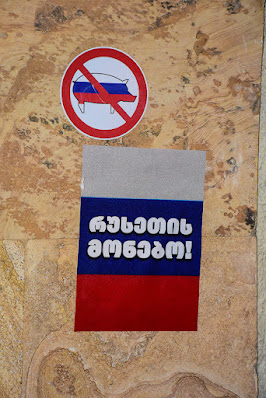 |
| The Georgian reads "Russian Slaves!" |
Another pall hanging over my time in Tbilisi was the increasing autocracy of the Georgian government which was run by the malevolent hand of the pro-Russian oligarch Bidzina Ivanishvili. Throughout my time in the country my Georgian friends and acquaintances lamented the drift of the Georgian government away from Europe and the goal of joining the EU. In April the government began to force through a "foreign agents" bill known colloquially (and derisively) as the Russian Law, as it was modelled in its wording and its intent on a similar law passed in Russia in 2012 that has been used to methodically crush all independent media, NGOs and civic society in that country. Street protests, attended by tens (sometimes hundreds) of thousands of ordinary Georgians outraged and worried by the direction of their country (including a number of my students and colleagues) raged throughout April and into May. The government eventually passed the law, but the stage was set for the current round of even larger protests against the transparently rigged election in October. One of my biggest hopes for 2025 is that the protests, supported by a sizeable majority of the Georgian population, succeed in the same way that the Euromaidan protests in Ukraine in 2014 did: with the sudden collapse of the Georgian Dream regime and the flight of Ivanishvili to Russia.
And then, before I knew it, it was graduation day and
I was packing up my life to return to Switzerland (to drop off my bicycle and
skis at my sister’s) and then on to home base in Bali. It was great to get back
to swimming every day, diving occasionally, working out on our backyard pullup
bars and in the new gym that had opened in town, hiking and kayaking. Our
little corner of Bali really is a great place to be based!
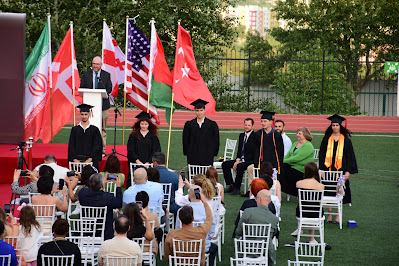 |
Graduation at QSI
|
In early August we set off on what was meant to be a
months-long hiking trip to the Himalayas. The plan was to spend August and
early September north of the Himalayas and free from the monsoon rains in
Ladakh and Zanskar, and then to move west to Nepal to try to hike a big section
of the Trans-Himalayan Trail, linking together the highland parts of a number
of classic hiking areas. We set up an itinerary with a Kathmandu trekking
agency (the permits and logistics of part of the hike are complicated) and then
flew to Leh, via Delhi. We had spent a wonderful summer trekking in Ladakh in
2012 and were looking forward to having more time to do longer treks.
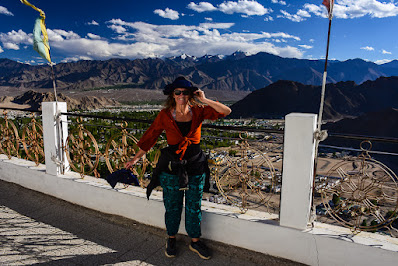 |
Shanti Stupa, Leh
|
 |
The first gorge of our trek
|
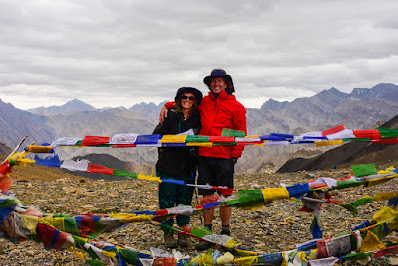 |
| Up on the Niri La |
As it turned out, trekking in northern India had
changed during our dozen years away. A number of the classic trekking routes
are now paved roads, and so finding a route that’s actually worth trekking is
hard. A few days of asking around turned up really high prices being asked for
horse rental, guides and cooks. In the end we went with a guy who wasn’t really
a full-time guide anymore, but who still does a few treks a summer. He came
recommended by friends of ours from Leysin who had trekked with his family
before, and his prices were still high, but much lower than what other agencies
were asking. We spent a few days acclimatizing in Leh, which was groaning under
the sheer volume of tourists, most of them domestic Indian tourists seeing
their own country, often on convoys of Enfield Himalaya motorcycles. Leh was
much busier and noisier than I remembered from previous trips in 2005 and 2012.
 |
The Himalayas are a botanist's playground
|
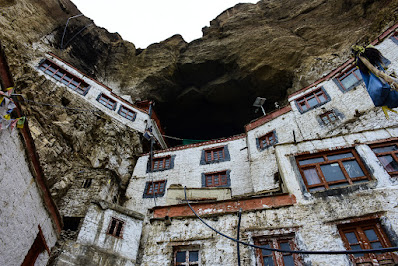 |
Phuktal Monastery
|
Eventually we hopped on a bus to Padum, Zanskar, which
would be our starting point. I had managed never to make it to Zanskar in my
previous visits, and it was high on my to-see list. We spent nearly 12 hours
taking the long way around, through Kargil, after floods damaged the shorter
direct route. We spent a couple of days buying provisions and meeting our team,
and then headed for the mountains.
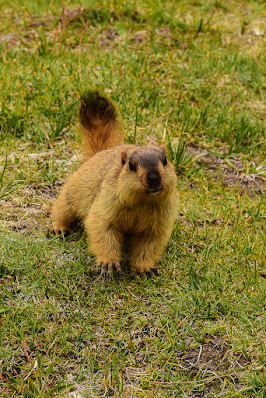 |
Marmot
|
 |
One way to get across with dry feet!
|
 |
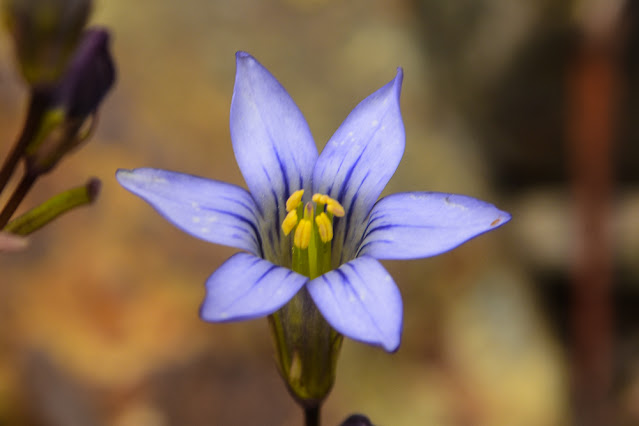
Himalayan wildflower
|
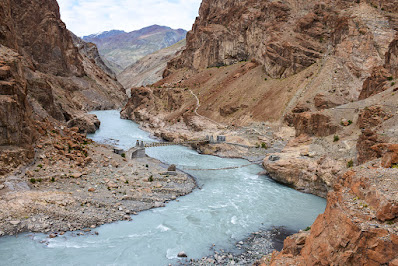
We spent 8 memorable days trekking from the village of
Zangla (35 km north of Padum) to one of the new roads at Tanze, and then
another 4 days from Tanze to the big Manali-Leh highway at Sarchu. Most of the
time there were no other tourists in sight, and very few locals. This part of
Zanskar has no roads, which is why we were trekking there and why very few
Zanskaris still live there. The scenery was stunning, and the walking was
physically demanding without being dangerous (unlike, say, our hike along the Inylchek
Glacier in 2019). There was lots of wildlife, including plenty of bharal (blue
sheep) and a few snow leopards whom we didn’t see but who left evidence in the
form of scat, paw prints and, one memorable morning, claw marks on the neck of
one of our sturdy horses. It was great to be out and about in the mountains,
and our horseman and our guide were good company (and cooked us some great
meals!). The geology and the stark desert landscape, deep slot canyons and
steep passes were all stunning and exactly what we were hoping for.
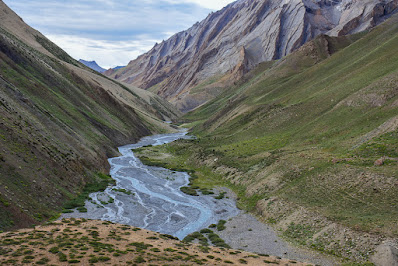 |
One of the rivers we followed
|
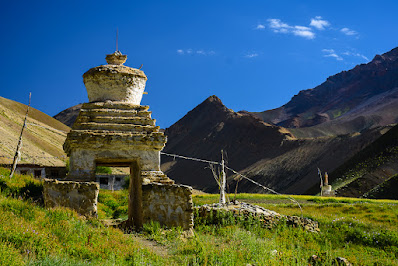 |
Gompa outside Shade village
|
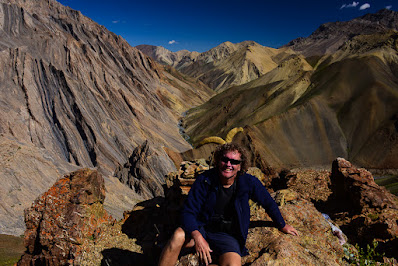 |
Great view below the Lar La
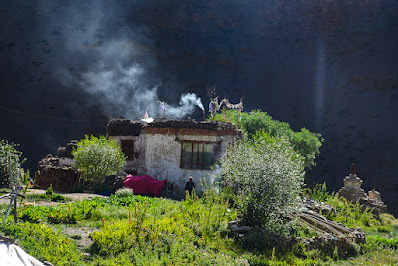 | Shade village
|
|
 |
The river gorge near Phuktal
|
 |
Showing off my swollen face
|
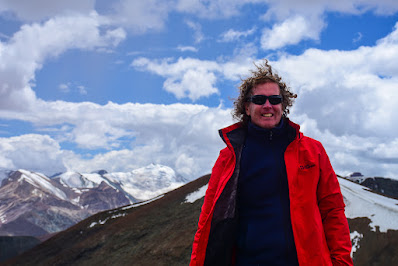
Sadly, what we weren’t hoping for was what happened
over the last few days of the trek, as I got a serious dental infection that
had my face swelling up like a balloon. I was worried, as we were completely
unable to get out any other way than by walking. Luckily I self-medicated with
antibiotics (Terri always has some on hand) and the swelling stopped getting
worse. Once we reached the road at Sarchu, we flagged down a car to drive us
straight to Manali, the nearest big town. There the hospital diagnosed a severe
infection, prescribed some more antibiotics, and said that this would be a
recurring problem until I had the offending tooth removed. I had broken the
tooth in 1990 and had a root canal performed on it, and this had long outlasted
its life expectancy. We decided to cut short our trekking, fly back to Bali and
have the tooth dealt with there.
 |
Proboscis monkey beside Santubong River
|
And so, unexpectedly, less than a month after setting
out, we were back in Bali. I had to stick around for a while to have the
offending tooth extracted, and then have an implant put in. We elected not to
return to the Himalayas, and instead stayed in Bali. I used some of the time to
look for a teaching job for the 2025-26 school year. I joined Search
Associates, and spent lots of time watching for jobs to pop up in schools that
interested me. My early target list included schools in rural Japan, in
Colombia, in Ecuador and in Oman. Oman and Colombia were slow rolling out their
available jobs, while Japan, with the falling yen, was no longer really
lucrative enough to justify working there. (How times change; in the 1990s and early
2000s working in Japan as an English teacher was the best-earning gig I have
ever had, before or since.) I talked with various schools, including in
Singapore, Phuket, Almaty, Cebu, Prague and Ecuador, but in the end it was an
unexpected school that I hadn’t even intended to apply to that offered the best
deal. It was also in a part of the world that both Terri and I are very
familiar with: Zambia. So in August of next year I will start teaching IB Higher
Level Mathematics and IB Physics at the American International School of
Lusaka. We are already looking forward to forays into the African bush, and we
may even end up re-using the camper insert from Stanley (sitting unsold and unused
in Cape Town) and installing it into another pickup truck.
 |
Bearded pigs on the beach, Bako
|
 |
Hiking in Bako
|
 |
Colugo, Bako National Park
|
We did get to do a bit of travelling around Indonesia
and the wider region. In September I had to go abroad to obtain a new and
improved visa, and Terri and I chose to fly to Kuching, on the Malaysian side
of the island of Borneo. I was last there in 2001, while cycling across the
north end of Borneo, and I remembered the city and nearby Bako National Park
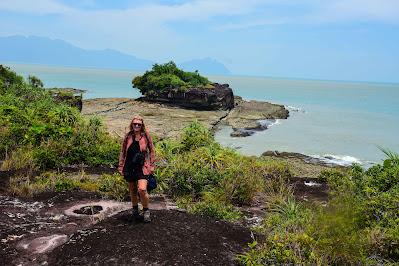
quite fondly. We were there for 8 days, and it was great fun. Terri really
liked the feeling of the city, and how easy it was to get around. We spent three
nights out at Bako, seeing the wonderful proboscis monkeys as well as bearded
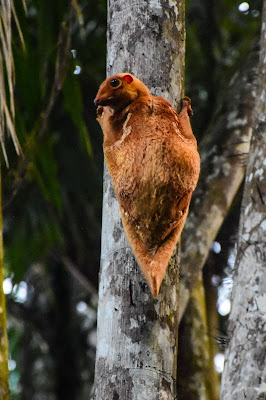
pigs, silvered langurs and some extremely mischievous macaques. We also spotted
culagos (so-called flying lemurs) and Wagler’s pit vipers, and had some
vigorous hikes around the park in search of hornbills (we struck out) and
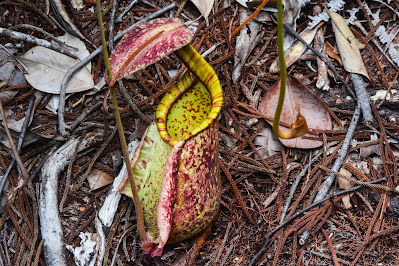
pitcher plants (we saw thousands, of several different species). We also
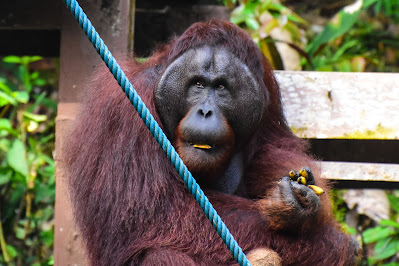
visited the orangutan rehabilitation center at Semenggoh (Terri’s first
orangutans, living wild in the forest reserve, but still keen on being fed
bananas at the feeding platforms), saw some Irawaddy dolphins in the estuary of
the Santubong River, and had a lovely hike through the dense primary forest of Kuban
National Park. All in all, it was a great trip and a reminder of the fabulous
nature that can be found in Southeast Asia.
 |
Pitcher Plant
|
 |
Big male orangutan, Semenggoh
|
 |
Clark's anemonefish, Jemeluk
|
 |
| Banded snake eel, Lipah |
 |
Whale shark, Saleh Bay
|
In early September we finally bought our own motor scooter,
a Yamaha Lexy that fits two big Westerners with ease. For years we had rented
smaller motorcycles, usually Honda Varios, and we were tired to trying to
squeeze onto them with shopping or diving gear. The Lexy has been a
game-changer for us, and now we wonder what took us so long to buy one. In
October we took it on a road trip for 8 days, out across Bali’s neighbouring
island of Lombok and onto the next island east, Sumbawa. We went to Sumbawa in
order to swim with whale sharks, something we had done before in 2016 in
Madagascar (and which I had also done years before in Donsol, in the
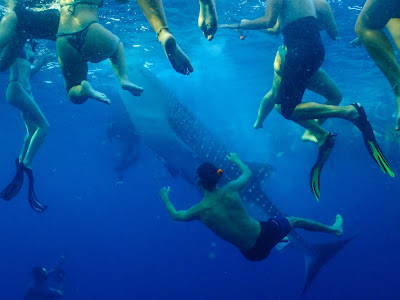
Philippines). The whale shark spotting was a bit of a disappointment, a crowded
tourist circus with a dozen boats and over 100 tourists in the water with one
pint-sized juvenile whale shark. The sharks are fed by krill fishermen to
attract them to their boats, and it has become a standard stopping-off point
for tourist boats plying the Labuanbajo-Komodo-Lombok route. Far nicer was the
little surf town of Sekongkang where we spent a couple of days relaxing and
watching Aussie and Spanish surfers riding the waves. On the way back we drove
through the highlands surrounding Mount Rinjani, and spent a lovely night at
the town of Senggigi on the northwest coast of Lombok.
 |
Tourist scrum around a whale shark
|
 |
Bunaken coral
|
In late November we ventured further afield, this time
by plane, to North Sulawesi. I spent a month in February, 2005 getting my
Divemaster qualification on Bunaken Island, and had spent a week muck diving in
Lembeh Strait in 2008, and I was keen for Terri to experience some of the best diving
in the world. It was rather more expensive this time than two decades ago, so
we rationed ourselves to one day of diving on Bunaken and three days at Lembeh.
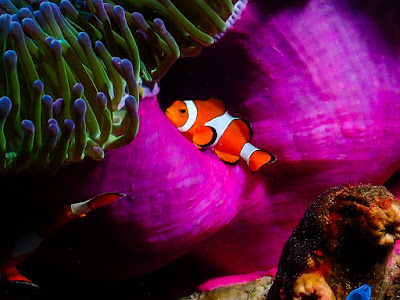
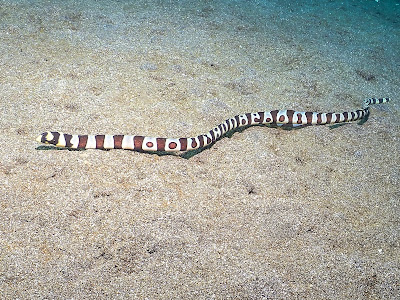
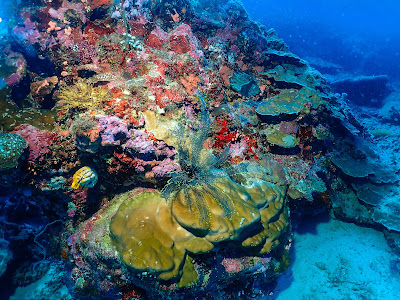
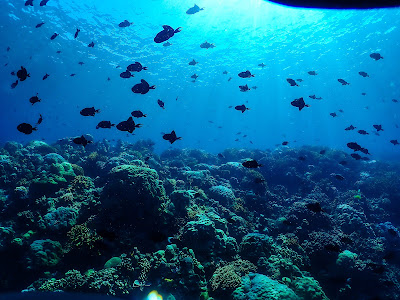
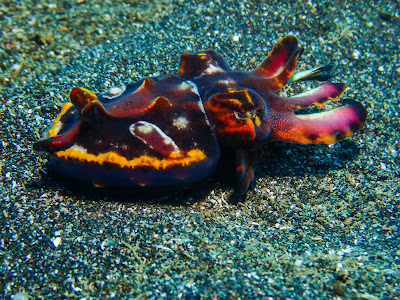
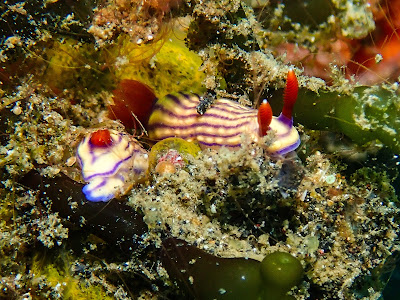
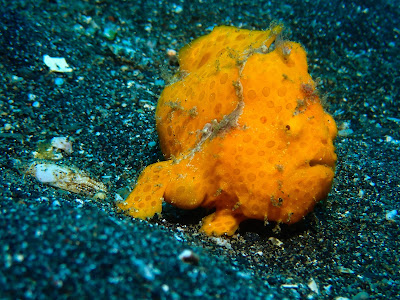
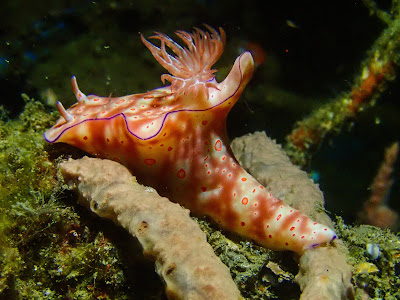
Both places were as memorable as I remembered: Bunaken’s coral and abundant
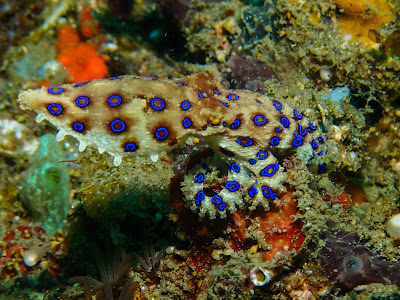
turtles were amazing, while we saw a lot of weird and wonderful underwater
creatures, many of them new for us, during our stay at Lembeh. I hadn’t had an
underwater camera when I was last at Lembeh, so I had a fantastic time snapping
photos. After we had finished diving, we spent a night at Tangkoko National
Park, an hour’s drive from Lembeh, where we saw the world’s smallest primates,
the otherworldly spectral tarsier, as well as some wonderful birds and the endearing
(and highly endangered) Sulawesi black macaques. We flew back to Bali
reinvigorated and excited about diving and wildlife.
 |
Blue-toothed triggerfish, Bunaken
|
 |
Green sea turtle, Bunaken
|
 |
Greater blue-ringed octopus
|
 |
| Flamboyant cuttlefish |
 |
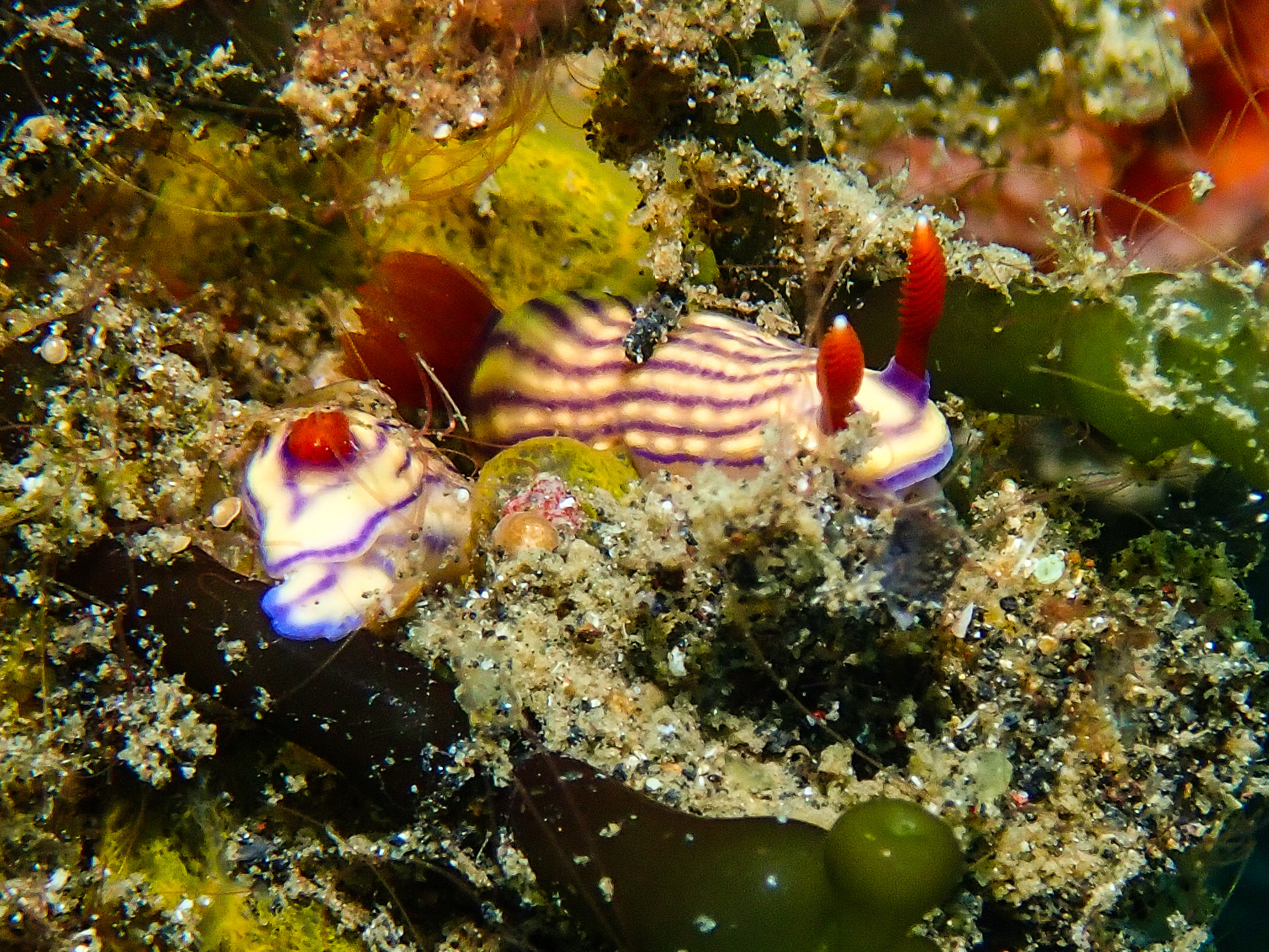
Hypselodorus whitei
|
 |
Spotfin frogfish
|
 |
Ceratosoma trilobatum
|
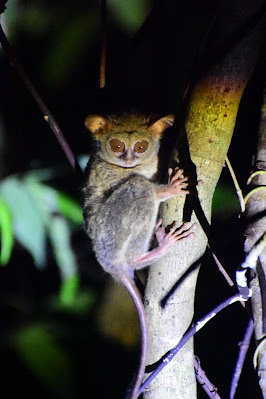 |
Spectral tarsier, Tangkoko
|
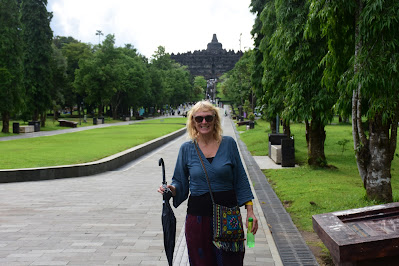 |
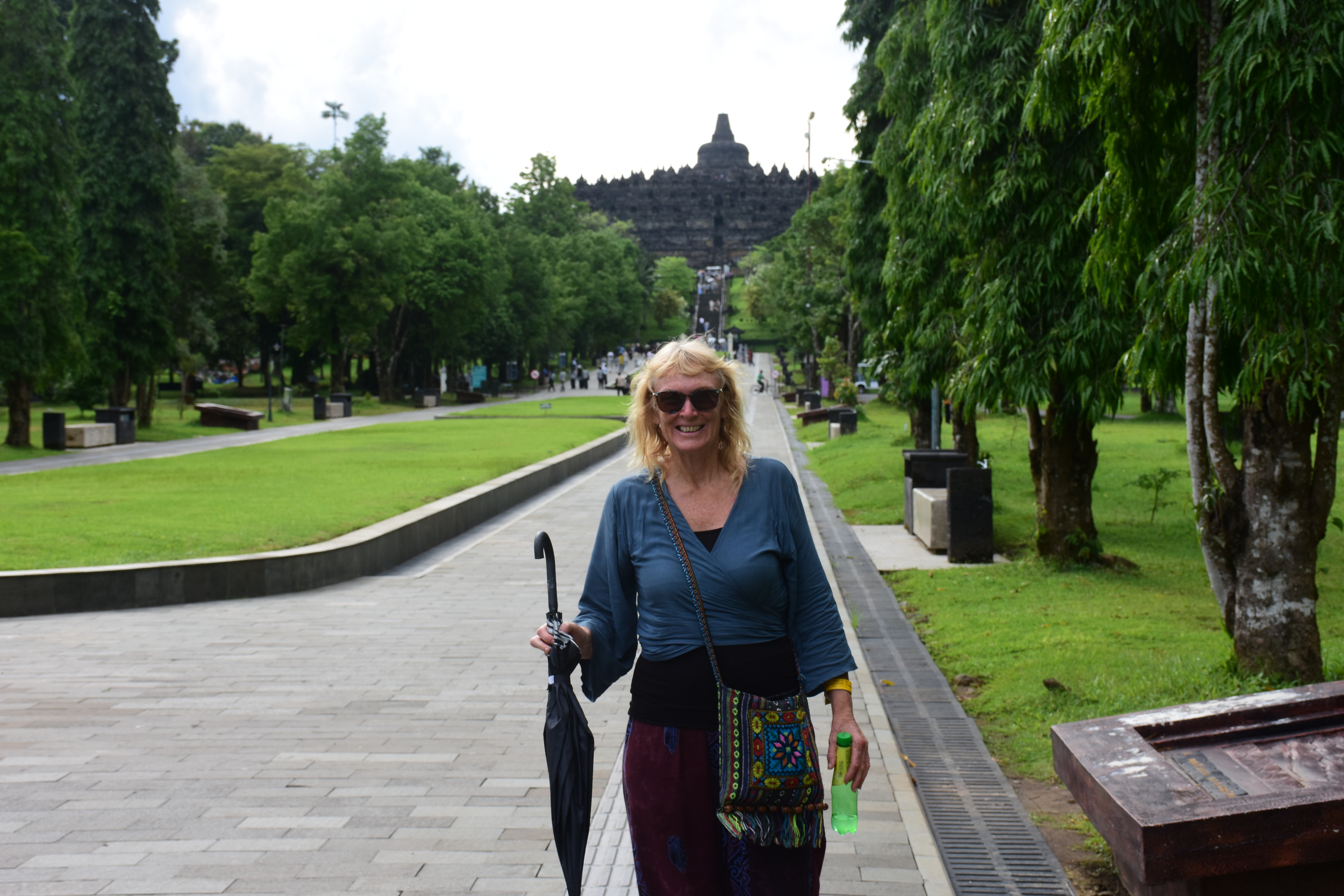
Terri finally makes it to Borobodur
|
Our final excursion for the year was a brief flying
visit to Yogyakarta so that Terri could see one of the great wonders of the
cultural world, the immense Buddhist temple of Borobodur. I had fond memories
of exploring Borobodur back in 1996, but much had changed since then. The
temple is a victim of its own success, and a draconian new visiting regime has
been introduced in the past two years, with limited numbers, expensive admission
and pre-set admission timings. We almost didn’t get into the temple; we had to
wait outside for several hours before entering in the last tourist wave of the
day. The sculptures and the setting and the history are as impressive as ever, but
the entire pre-packaged mass tourism experience was disappointing. Luckily
Prambanan, the old Hindu temple complex near Yogyakarta, was far less
restrictive and despite the tsunami of Indonesian school groups while we were
there, it was still a great place to walk and explore. I was glad, though, that
I had had the chance to see both places decades ago when they were less crowded
and when I could take my time to explore in depth.
 |
On the top level of Borobodur
|
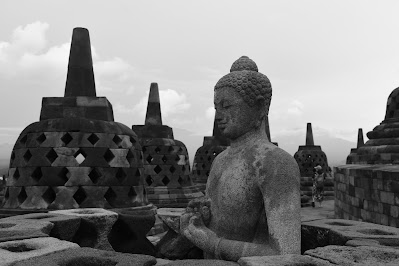 |
Buddha statue atop Borobodur
|
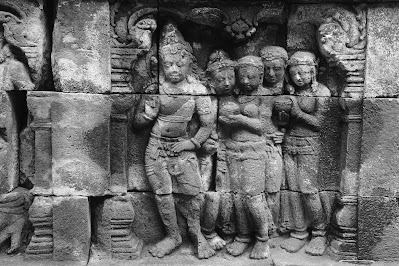 |
| Borobodur relief |
On the way home from Denpasar Airport, we stopped at a
private hospital that caters to medical tourism and both had extensive physical
checkups done. As we age, it’s probably a good idea to spot problems before
they arise, but we were both very happy to have no detectable health issues. As
I approach my 57th birthday, and still thinking about the death of
my mother last year, I definitely am more aware of my own mortality and the
limited supply of healthy years that I have left, so I’m glad that I’m as
healthy as I am.
 |
Shiva statue at Prambanan
|
While we have been occasionally out and about in
Southeast Asia, while we have been in Lipah there has been a big project going
on, with a three-storey extension to our house being built. It has been a
slow and somewhat frustrating process for Terri to oversee, and we are living
in a certain degree of noise, dirt and squalor, but when it is finished, I
think it will revolutionize our life here. The final story of concrete is just
about ready to pour, and after that we will have an immense new terrace to sit
on and gaze out over the Bali Sea.
 |
Bas relief at Prambanan
|
So that’s been my 2024: less travel than usual, but
still a bit of re-exploring familiar places, along with earning some filthy
lucre and planning for future adventures. I hope that you, my dear readers,
have found your own fun and joy in 2024, and that 2025 brings more in the way of
peace, fulfillment and learning. Until the next time, I remain
Yours Truly
Graydon
 |
Gentian
|