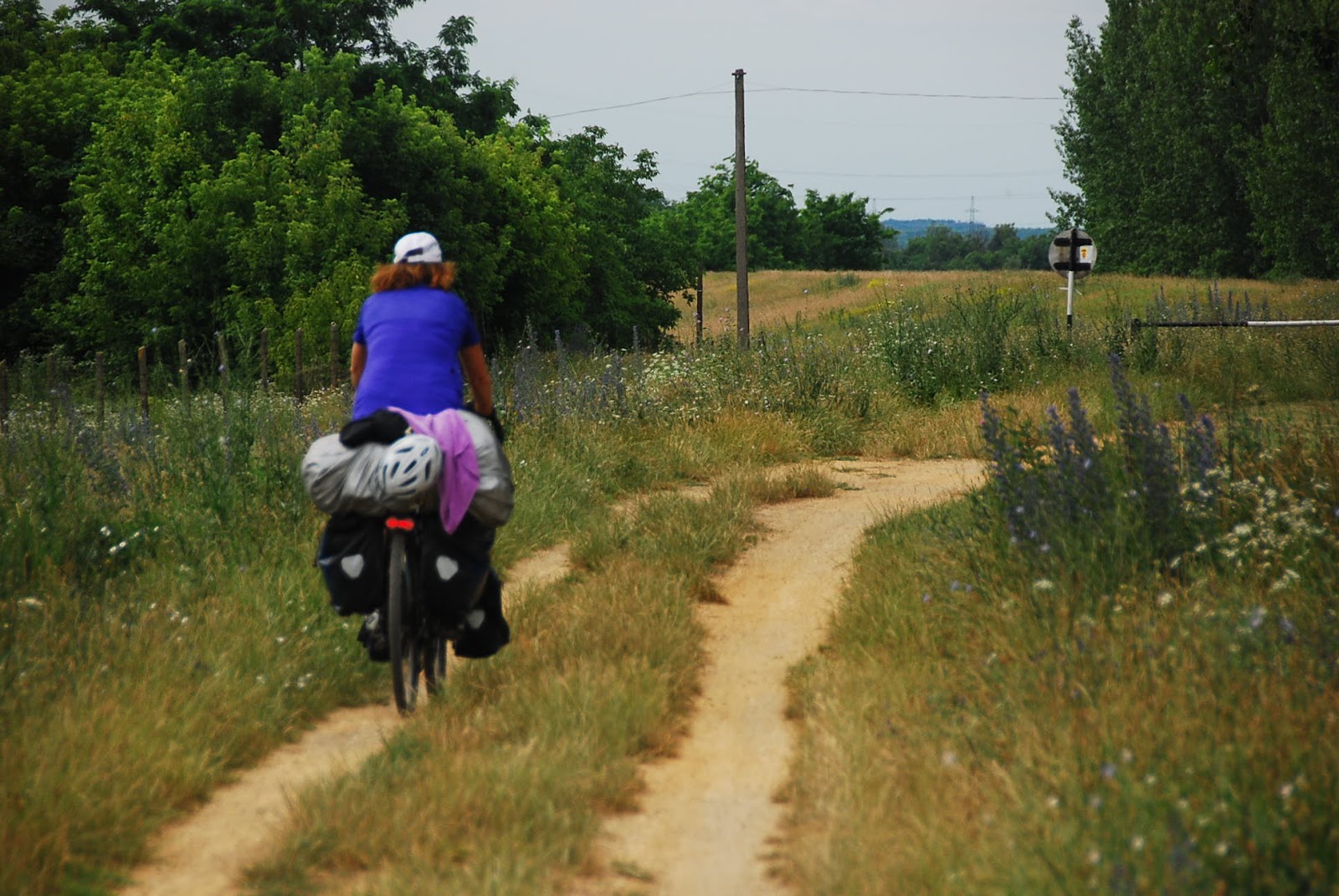
Stage Four—Yugoslavian Yin and Yang
Once across the Hungarian-Croatian border on Monday, June 22nd, where we saw our first border formalities of the trip (Croatia is in
the EU but not in the Schengen Zone) we had a few kilometres of unpleasant
cycling, along a narrow road with no real shoulder or bike path and some
fast-moving trucks.
 |
| Welcome to Croatia! |
One of them actually
ran Terri right off the road, much to her annoyance. Luckily our bike path turned left away from
the main road soon enough and onto the quiet road we would follow the rest of
the day. The scenery was fairly similar
to Hungary: a flat agricultural plain
bordering the river, with small farms and a smattering of vineyards. Our first village, though, showed that we had
crossed a border, as it was half-deserted and partly in ruins, with little
economic activity evident. Banks and
ATMs were nowhere to be found, and the only shops we found were tiny
mom-and-pop corner grocery stores outside which men gathered to drink beer. It turned out that we had arrived on a
national holiday, which went some way to explaining the somnolence, but this is
also the poorest corner of Croatia, still scarred by the 1991-95 war. We had our biggest luggage-carrying climb of
the trip to date, pedalling 100 metres uphill over a bend in the river, past
more prosperous-looking country houses set amidst apricot orchards and
vineyards. We had pizza in a slightly
larger town after 60 km which finally had an ATM, and then continued another 25
km to a tiny village called Kopacevo. As
had been the case all day, it was a mostly Hungarian-speaking village, thanks
to the 1920 Treaty of Trianon that sliced away huge chunks of Hungary to give
to the new state of Yugoslavia. We found
an almost-deserted campground with a gargantuan kitchen for our use, and cooked
up some ravioli to accompany our bottle of Schwabenblut.
The next
morning was Terri’s birthday, so I got up early to raid the grocery store for a
special breakfast of pancakes in the kitchen.
After that we soon rode into the large provincial capital of Osijek, a
sprawling metropolis after the tiny villages of the previous day. We didn’t pause long, heading out of town on
a busy road until we finally were directed onto a less-trafficked parallel
road. At lunchtime we found ourselves in
Vukovar, a town still deeply scarred by the 1991-95 war, with its water tower
still bearing the marks of the pounding it took from Yugoslav forces.
 |
| Vukovar's emblematic water tower, a war memorial |
Looking for a place to eat, we discovered
that while there were cafes and bars everywhere, it was almost impossible to
find a restaurant serving food.
Eventually we were directed to a lovely spot beside the Danube, where we
waited out a passing rainstorm. After
lunch it was a pleasant afternoon of riding through a series of small
wine-producing villages, each one down a small, steep incline from the plateau
on which we spent most of our time.
Luckily we had fairly strong tailwinds to propel us on our way. By 5 o’clock we were at the end of the road
in Croatia, the border town of Ilok.
 |
| Our view over the Danube from our luxury flat |
We
splurged on a fancy tourist apartment overlooking the Danube owned by a family
who had fled Vukovar from 1991 to 1998 because of the war. Taking advantage of having a well-equipped
kitchen, I cooked up a birthday steak dinner for Terri washed down by some
excellent local Slavonian wine.
 |
| The chef is in the house! |
After only two
days in Croatia, we crossed into Serbia the next morning over an imposing
bridge. It was spitting rain as we went
through border formalities, and it continued to rain off and on all day. By the time we reached Novi Sad and had a
late lunch, the rain had strengthened into a miserable downpour. Since the ride into Belgrade from Novi Sad
was supposed to be not much fun anyway, we decided on the spur of the moment to
take advantage of the rain and take our bikes on the train straight to
Belgrade. It took forever to find the
train station, and more time to figure out what platform to get on, but by 6:30
pm we were on the train using Terri’s iPhone to find a place to stay in
Belgrade. We had a long and typically
Balkan conversation with a middle-aged Serbian man named Dragan. He was well-educated and clever, but consumed
by a sadness at the tragic history of his country. He had fought in the war against Croatia and
was keen to set us straight about the Serbs being the good guys in the
war. He held up Serbia as the bulwark
against the Ottomans, sacrificing their own freedom to save the rest of the
continent from the Turks. It was
interesting to talk to him, but his deep-seated blind nationalism was all too
drearily familiar to me from my previous trip through the former
Yugoslavia. By 8:30 we were pushing our bicycles
through the darkening streets to the ridiculously ornate Baroque furnishings of
the apartment we had rented.
 |
| Kalemegdan fortress, Belgrade |
We had a proper
day off in Belgrade the next day, exploring the city on foot and absorbing some
of the cultural energy that pulses through the streets. Our first port of call was the Kalemegdan,
the massive fortress at the junction of the Danube and Sava rivers that has
been fought over for centuries.
 |
| Transformer statue, central Belgrade |
On the
way we passed the pedestrian streets of the city centre, decorated by huge
Transformer statues made from car parts and featuring more ice cream stands per
block than even Italy. The fortress
itself was impressive, with expansive views to the north over the flat
Hungarian-speaking plains of Vojvodina and to the west over the sprawling
Soviet-era suburbs of the city. The
military museum inside the fortress was left unvisited, although Terri relived
her days in military intelligence by identifying some of the tanks parked
outside. We then wandered back through
the pedestrian streets of downtown, enjoying the relaxed atmosphere of a
capital city in summer. We had a great
lunch at a local joint recommended by our landlady, then hit the grocery store
across the street from our flat to restock our panniers and cook up another
feast in the kitchen before collapsing in bed early in our
aircraft-carrier-sized bed.
Refreshed by
our day out of the saddle, we left Belgrade the next morning after an epic
30-minute tussle with the lock that kept our bicycles safe in the depths of the
subterranean cellars of the building. It
was raining, and we were glad for frequent EV6 signs that swept us neatly out
of town and over the Danube to the left bank.
After crossing our bridge on a dedicated bike lane, we were directed
down a muddy track through the grass to another quiet dike-top path that got us
away from the heavy truck traffic of the main road. As we rode along, we passed a surprisingly
beautiful landscape beside the river, with quiet marshy backwaters teeming with
ducks and other birdlife. We pushed
along, past old grim factory towns to a radler stop in a little pizzeria, and
then continued along a busyish road to a small ethnically Hungarian town,
Skorenovac (Szekelykeres in Hungarian), where we came across a piece of Serbian history during a late
lunch: a restaurant owned by the family
of Zoltan Dani, an officer in the Serbian army who managed to shoot down an
American F-117 Stealth fighter in 1999 during the NATO air war against Serbia arising
from the Kosovo conflict. Posters of two
different movies connected to the incident adorned the walls. Afterwards we tossed in the towel a bit early
from an uninspiring ride and took a room in a small, unpretentious restaurant
with hotel rooms in the back. The rain
had finally fled, and we eschewed the restaurant in favour of a takeout roast
chicken, fruit and beer from the market stalls across the road.
Stage Five—Through Romania’s Iron Gates
We rode under
brilliant blue skies through a peaceful, bucolic countryside the next morning
east towards the Serbian resort town of Bela Crkva. It was easy riding, although we had small
undulations as the road veered inland from the Danube. Bela Crkva was a town with a pretty setting
around a series of small lakes. There
was some sort of festival in town, with lots of girls dressed in traditional
costumes and others incongruously wearing cheerleader outfits and twirling
batons. A look at the various churches
in town told a story of the various ethnic and religious strands woven through
the area: a Catholic church for the
Hungarians and Croatians, a Romanian orthodox church, a Serbian orthodox church
and even a Russian orthodox church. We stopped in a café for our daily radler
and fries, changed money, met our second French couple on a tandem in as many
days, and then pedalled off towards the Romanian frontier. This involved a bigger hill climb than we
were used to, as the road headed up and over into the valley of another tributary
of the Danube. By the time we had
freewheeled down to the bridge at the border, we had built up quite an
appetite. Luckily a little restaurant
stood just on the Romanian side and we tucked into a hearty and well-earned
lunch featuring the local specialty of tripe soup, which was a lot tastier than
it sounds!
We had another
climb in front of us, 300 vertical metres uphill to cut a series of meanders in
the river and get back to the Danube proper.
Although it was pretty warm and Terri was a bit apprehensive about our
first sizeable climb of the trip, it was relatively straightforward (especially
fuelled by lunch).
 |
| At the top of the first big climb of the trip, Romania |
At the top we read
that we had entered the Iron Gates National Park, and we descended for 10 km to
the valley of the Danube through a lovely wild forest. All along the left bank of the river the
foothills of the Carpathian Mountains rose up to inviting-looking forests. We had planned to find some wild camping that
evening, but as it got later, we still hadn’t seen any likely-looking spots
amidst the farm fields. We passed through
the scruffy-looking town of Moldova Veche, a vision of post-Soviet apocalyptica, and
found a surprisingly nice hotel for 70 lev (about 18 euros). We sat out in the café over good beer and
dreadful red wine, eating very meaty stews while a local crowd of single young
men got louder and louder as the beer bottles piled up on their table.
The next day
was definitely the scenic highlight of the entire trip. Our route led along the Danube through the
canyon known as the Iron Gates, where the Danube forces its way through the
barrier of the Carpathians. Not far from
where we had stayed, the farmland ceased and we rode through a landscape of
forests and fishing spots, full of perfect camping spots. There were Romanian fishermen camped in
almost all of these spots, but I’m sure we could have found one to
ourselves. There were towns marked on
our map, but these were ghost towns, abandoned Communist concrete monstrosities
from the Ceausescu era. It meant that we
had few restaurant options for lunch, and even had problems finding a radler,
although a tiny little café eventually came to our rescue. As dismal as the towns were, the scenery was
magnificent, with steep-sided mountain slopes cloaked in dense forests tumbling
right down to the river. The road on the
Romanian side was almost deserted, as truck traffic was banned through the
heart of the gorges, and surprisingly flat given the terrain. Looking across the river, the road on the
Serbian side looked far less inviting for cycling, with heavy traffic and an endless
series of tunnels. On our side, despite
a landslide that had almost blocked the road in one spot, the pavement was in
good shape and perfect for riding, as well as being blessedly tunnel-free.
 |
| Iron Gates scenery |
The Iron Gates
are redolent of history, and our first taste of it was a strange-looking
structure on the Serbian shore that proved, upon inspection through binoculars,
to be a large excavated Bronze Age settlement under a protective roof. Soon afterwards the swiftly flowing waters
started to pool in the huge hydroelectric reservoir of the Iron Gates Dam, and
we passed the half-submerged towers of a medieval castle. Somewhere else along this stretch, Patrick
Leigh Fermor (in the course of his epic walk across Europe in 1934) visited a
completely Turkish village on an island in the middle of the Danube that has
vanished completely below the waterline.
I watched for protruding ruins, perhaps a drowned minaret, but didn’t
see anything. In Roman times, this was
where the marauding legions of the Roman Empire crossed north into Dacia to
subdue the troublesome tribes on the other side of the Danube. Although the Romans were in Dacia for less
than 100 years, modern Romanian historic mythologizing ascribes a founding role
to these soldiers.
We looked for
wild camping spots as the day wore on, but instead we were diverted by a vision
of beauty. After a stiff climb up to
another half-abandoned industrial wasteland of a town (Dubova), we spotted a
sign for an upcoming nearby pensiunea
and decided to call it a day. When we
arrived, it looked far too grand for the likes of us, a vision of four-star
luxury with BMWs parked outside. The
owners were amenable to negotiating down their 100 euro rack rate, and for a
hair under 50 euros, Terri decided to treat us both to a night of luxury. We swam in the pool, sat sipping red wine
(much less awful than the previous evening’s plonk) and absorbed the grand
views. The hotel was located on a wide stretch
of the reservoir between two gorges, and we looked across at towering limestone
cliffs that lit up as the sun crept towards the horizon. It was a perfect setting, in the most
impressive scenery of the entire day, and we slept the sleep of the dead in our
huge king-sized bed.
The next
morning we found that after the low traffic and non-existent population of the
previous day, we had re-entered modern Romania.
 |
| Terri with Decebalus, Romania |
We cycled past dozens of new pensiuneas clustered along the water’s
edge, then past the huge sculpted head of the Dacian king Decebalus carved into
the cliffs beside the road in the late 1990s by a Romanian business tycoon,
Iosif Constantin Dragan. It was a pretty spot for
photos, but it was also another instalment in the myth-making that
characterizes so much history in eastern Europe. We climbed up, up, up away from the hotels
and weekend cottages that surround the town of Eselnita, and then descended into
the larger city of Orsova where we picked up all the heavy truck and bus traffic
that had been diverted around the gorge.
It was an unpleasant 20-km stretch along the river past the dam itself
and into the city of Drobeta-Turnu Severin.
 |
| Camping on a grassland that once was a collective farm |
Here we
stopped to recover from the head-down survival riding over perhaps the slowest
lunch of the trip, with an old-school waitress prone to disappearing for half
an hour at a stretch. We followed
quieter roads out of town along the river and ended up camping wild in an
abandoned collective farm that has returned to nature. There we gorged ourselves on the most
delicious peaches we had ever eaten, plucked lovingly by old man from his own
garden and sat watching the sun set the savannah alight in a scene oddly
reminiscent of East Africa.
 |
| Southwestern Romanian countryside |
Our last day in
Romania ended up being the longest day of the entire trip, the only time we
went over 100 km for the day. We awoke
in our abandoned farm field and spent much of the day rolling through tiny
villages where horse carts outnumbered cars, on roads that varied from perfect
new EU-funded asphalt to rutted cart tracks across the fields.
 |
| The bit of the road that wasn't paved |
We kept almost
exact pace with the local beer delivery truck, passing them as they unloaded
crates at cafes and shops, and then being passed halfway to the next village
with friendly waves from the delivery guys.
We eventually popped out on a main road and had a fairly terrifying 10
km of dodging speeding trucks before the traffic calmed down and we approached
the last border of the trip. We had
planned to sleep one last night on the Romanian side of the river, but Terri
decided we could do another 10 km to get us across the new bridge and into
Bulgaria.
 |
| Sunflowers, southwest Romania |
As we trundled along a back
road into town from the bridge, my rear hub, which had made strange sounds
earlier in the day, suddenly seized up and made a very unpromising and very
loud crunch. I realized that I had
broken a bearing, and that the wheel was going to have to be rebuilt. We made it another kilometre to the first
truck stop we could find and took a surprisingly nice room. I demolished a huge plate of the local
specialty, satch (a giant meat and veg stirfry), but Terri, normally ravenous after a long day in the
saddle, barely touched hers.
Stage Six: Bulgarian Beauty
It was the
start of 24 hours of severe intestinal distress for Terri; luckily we were
already planning to take the day off to get my wheel fixed, so she could have a
bit of rest. We got a lift into the
Soviet-era concrete of downtown Vidin and, with the help of our driver, a local
guy who had lived for 20 years in Italy and with whom I spoke in my pidgin
Italian, we located a bicycle repair specialist whose shop was in his garden
shed. He took a look at my wheel, told
me to follow him on one of his bikes and took me to a bike shop to buy a new
hub (for all of 12 euros). Then he told
us to come back in an hour and a half and set to work stripping the spokes and
rim off the old, destroyed hub and rebuilding the wheel on the new hub. Terri found a hairdresser and had a haircut,
pedicure and scalp massage while I wandered the streets eating. The bike mechanic was done the wheel by the
time we got back; he reminded me of similar gifted mechanics who had fixed my
bikes over the years in places like Tbilisi and Baku and Sochi. Armed with the new wheel, we caught a cab back
to the hotel where Terri went back to bed feeling very unwell.
At this point,
wondering what to do next, I got a message from a former student, Victor, who
lived in the area. When he heard that
Terri was ill and that we were kicking around in Vidin, he hopped into his
truck and drove us the 20 km out to the commercial farm that he runs in the
village of Tsar Petrovo.
 |
| Teachers-student reunion with Victor |
He installed us
in his guest cottage and we sat outside drinking good local wine, eating a
great meal that his housekeeper had prepared and hearing about how a
21-year-old who had failed out of university through sheer apathy had been
transformed into a keen farmer who had won the Bulgarian Farmer of the Year
award the year before. It was great to
see a young man who had found his passion in life and become so successful.
We spent the
next day touring around the farm with Victor, playing with the drone that he
uses to survey his fields, checking out the irrigation system, riding in
combine harvesters (one of Terri’s life-long dreams) and racing around on a
quad bike.
 |
| Flying drones on the farm |
It was a wonderful day, and
we finished with another great meal and more stories from Victor. It’s always a welcome development in a long
trip when for a little while you cease being a tourist and fit into the life of
someone who lives in the country, and see the country in a completely different
way.
 |
| Storks following the combine harvester |
Through Victor we learned a lot
about the poverty and unemployment that blight this corner of Bulgaria; about
corruption and gangsters; about trying to get his workforce out of their
Communist-era apathy; about how cheap land and houses were around Tsar Petrovo;
about the enormous depopulation of the villages.
 |
| Seriously happy looking shotgun passenger! |
The next
morning Victor gave us a lift about 20 km out of town to shorten what promised
to be a long day. We waved goodbye on
the side of the road, grateful for his hospitality and ready for the last three
days of our ride. That day proved to be
a long one, both in terms of distance (93 km) and in terms of time. Terri found it challenging, as it was by far
the hilliest day we’d had so far, climbing away from the Danube and then
undulating from valley to plateau all day.
It wasn’t terribly hot, but it was still sweaty work climbing up the
escarpments, and when we came into a village looking for a restaurant that
wasn’t there and Terri saw the next climb rising in front of her, she almost
lost it. I quickly directed us off the
road to a riverside meadow and we had a picnic and a swim which restored
spirits. The afternoon continued to be
hilly, and we decided to look for a spot to camp wild, but could not find any
running water.
 |
| Northwest Bulgarian traffic |
Eventually, nearing dusk,
the road took a final dip and led us down, down, down into the city of Montana. I parked Terri in a café where she wolfed
down a plate of hot fries and quaffed a beer in no time flat while I cycled
around looking for a hotel. It took a
while, but I found quite a nice little hotel for a decent price. We went back to the café for a huge dinner,
and then collapsed tired into bed to sleep deeply for over 10 hours.
The next
morning I had to make time for a medical issue.
I had, it seemed, been bitten by a tick the day we camped on the
abandoned farm in Romania, and an expanding bulls-eye target of red had been
expanding around the bite day by day.
Concerned by the prospect of getting Lyme disease, I went to the
pharmacist who suggested a few days of doxycycline and an injection of
something mysterious whose identity I never really figured out. I had to go across the street and pay a nurse
to do the injection. The total cost for
the antibiotics, the vaccine and the injection was 3 euros, a definite bargain.
 |
| Petrohan Pass, the highest point of the trip |
Once that was
out of the way, Terri found a taxi driver willing to drive her and her bike up
to the top of the Petrohan Pass, the 1400-metre barrier between us and
Sofia. Her legs were tired after the
previous day’s exertions, and she was still feeling a bit dicey after her
illness, so she left the climbing to me.
I love climbing passes on bicycles, and I had a great time rolling up
into the Balkan range, through a series of small villages and then up through a
lovely hardwood forest. I left town just
before noon, and it took about four hours in total from Montana to the top of
the pass, where I found Terri sitting in a snug little restaurant reading and
eating a delectable stew. It was
noticeably cooler at the top, and we sat inside beside the fire as I had some
stew as well, having built up a tremendous hunger since breakfast. Eventually we both climbed onto our bikes and
started rolling down the other side of the pass, looking for a place to camp,
but instead we ended up staying at Andreev Khan, a lovely fake-old caravansarai set
in a big garden beside the road, with a series of fish ponds. It was not very expensive (20 euros) and it
was a very pretty setting to sit and sip wine and eat as dusk fell. We slept very well again.
 |
| Andreev Han |
Now that we
were over the pass, not much stood between us and Sofia, about 60 km away. We rolled downhill, took a short climb over a
secondary pass, and then coasted downhill most of the way into the city. We had a pizza and sausage lunch in the city
of XXXXXXX which marked the end of the downhill. It was hot as we trundled across the flat
valley floor and into the bustle of the capital. By dumb luck we chose a route into and
through the city that had bike lanes, and then climbed up towards the leafy
suburb of XXXXXX where Victor’s father’s house was. Victor’s brother Igor was going to be staying
there that evening (his father was on the Black Sea coast) and we looked
forward to another reunion with a former student. As we got closer to where Google Maps said
the house was, the streets got steeper and steeper and narrower and narrower
and Terri ended up pushing her bike and voicing her displeasure at the
steepness. We couldn’t find the house
and settled down to wait for Igor’s arrival, which was in about half an hour at
the wheel of his father’s convertible.
It turned out that Google Maps, and most other city maps, don’t have the
street’s location correct. Maybe this is
a security precaution, as the Gatsbyesque mansion that Igor led us to was once
the personal home of Todor Zhivkov, the long-serving Communist boss of the
country from 1954 to the downfall of Communism in 1989.
 |
| Olympian feast in Sofia with Xander and Igor |
Our last two
days on the road were spent in the lap of luxury, eating like kings in a couple
of beautiful restaurants, swimming in the pool, packing our bicycles into boxes
and swapping stories with Igor, now an engineering student in Sydney, and his
friend Xander, with whom he had just finished a high-speed road trip around
Bulgaria.
 |
| Igor and I atop Vitosha |
We went for a drive and hike
up the Vitosha mountain range that rises directly behind the house, and after a month
of lots of cycling and little walking, our legs were sore for several days
afterwards. Sofia seemed a world away
from the grinding poverty of the northwest of the country, and made a fine spot
to end our month-long cycling odyssey that had started in Vienna.
 |
| Our oasis of luxury in Sofia |
I was pleased
with the route we took. Although it was
very flat most days, we had interesting historical, cultural and natural sights
to look at, and the heat and winds gave us some challenge. I particularly liked going back to Hungary,
but the two countries that I think I would most want to explore further are
Romania and Bulgaria. They will have to
wait for my return to Europe, and I don’t know when that will be. As we took our flight from Sofia back to Geneva
so that Terri could return to Leysin for the last summer term of her career, I
was already looking forward to my trip to Scandinavia, due to start only 48
hours later. No rest for the cycle
tourist!!